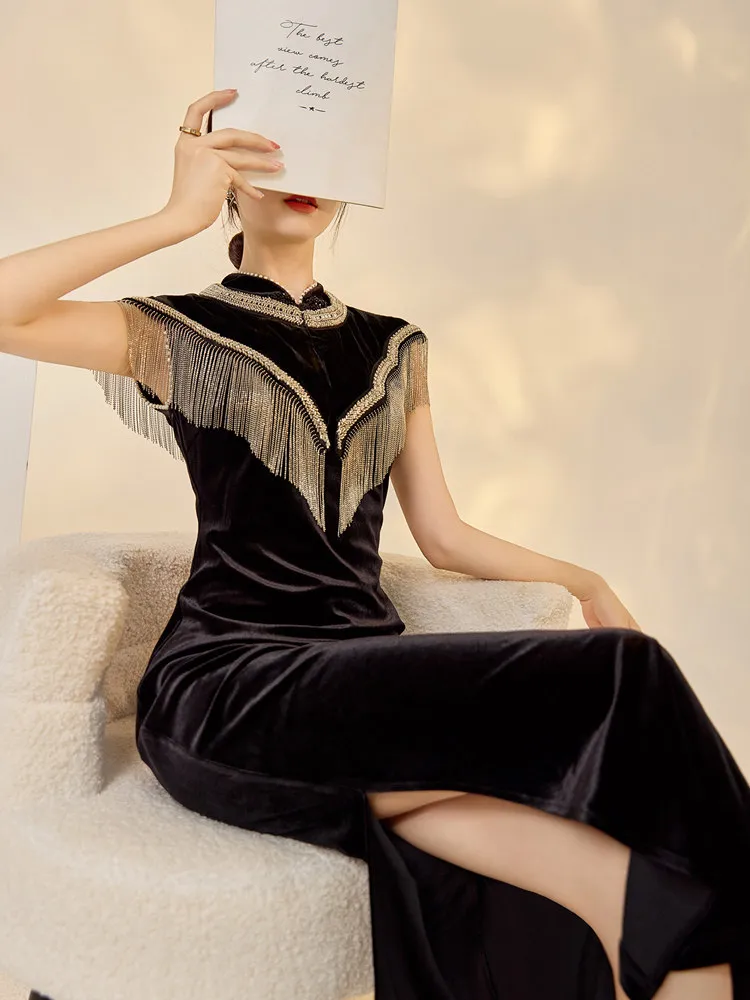
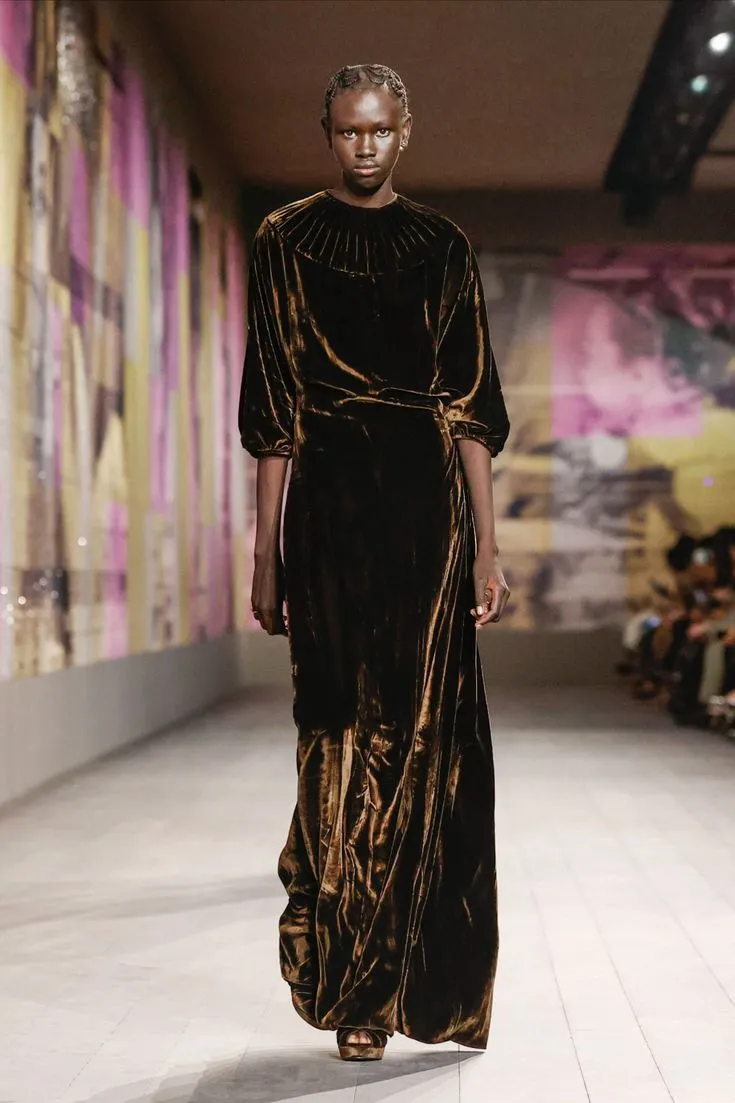
The New Power Fabric: How Velvet Is Transforming the American Workplace in 2024
Photo: RobbieIanMorrison, CC BY-SA 4.0, via Wikimedia Commons
The corner office has a new dress code — and it is considerably more interesting than anyone anticipated.
Across American professional environments, from the glass-walled conference rooms of Silicon Valley to the law firms and investment houses of Midtown Manhattan, something is shifting in the way ambitious professionals choose to present themselves. The shift is tactile as much as visual. It is the unmistakable presence of velvet: in structured blazers, in jewel-toned separates, in the kind of considered, premium dressing that signals not merely competence, but a particular brand of self-assurance that the conventional business suit no longer conveys with the same authority.
This is not a fringe development. It is a measurable evolution in what American professionals understand power dressing to mean in a post-pandemic corporate landscape.
The Collapse of the Old Uniform
To appreciate why velvet has found a foothold in the workplace, it is necessary to understand what it is replacing — and why that replacement was inevitable.
The traditional markers of corporate authority — the charcoal suit, the white dress shirt, the muted tie — were designed for a professional world built on conformity and institutional deference. Uniformity communicated belonging. Standing out carried risk. For decades, American corporate culture rewarded those who dressed as though they were already part of the institution, rather than those who dressed as though they intended to define it.
The pandemic disrupted this logic in ways that continue to reverberate. Remote work, the reconfiguration of office hierarchies, and the broader cultural conversation about authenticity in professional spaces collectively eroded the authority of the old uniform. When professionals returned to physical offices, many found that the previous dress code had lost its symbolic power. The question was no longer what the institution required of them, but what they wished to communicate about themselves.
Velvet, with its centuries-long association with authority, refinement, and deliberate self-presentation, offered a compelling answer.
Velvet Beyond the Executive Suite
What distinguishes the current trend from earlier, more limited appearances of velvet in professional contexts is its breadth. This is not simply a matter of senior executives adopting richer fabrics for important presentations. Velvet is appearing at every level of ambitious professional life, in industries and settings that would have seemed unlikely candidates even five years ago.
In venture capital and private equity offices in San Francisco and New York, velvet blazers in deep navy, forest green, and cognac have become a recognizable presence at pitch meetings and investor events. The choice is rarely accidental. Professionals in these environments are acutely aware of the signals their appearance sends to founders, limited partners, and competitors alike. A velvet blazer communicates something that a conventional wool counterpart does not: an ease with luxury, a comfort with standing out, and a confidence that does not require the camouflage of institutional conformity.
In creative and media industries — advertising agencies, publishing houses, design studios — velvet separates have become particularly prevalent among professionals who wish to bridge the aesthetic sensibility of creative work with the authority that client-facing roles demand. A jewel-toned velvet blazer worn over tailored trousers occupies an interesting and useful middle ground: it reads as creative without surrendering the gravitas that commercial environments require.
Even in more traditionally conservative sectors, the presence of velvet is growing. Female executives at financial institutions and law firms are increasingly incorporating velvet blazers and structured velvet trousers into their professional wardrobes — a choice that simultaneously honors the formality those environments demand while asserting a distinctly individual version of authority.
The Psychology of Tactile Authority
Workplace psychologists who study professional appearance and self-presentation have noted that the shift toward premium textiles in professional dressing reflects something deeper than fashion preference. The concept of enclothed cognition — the documented psychological influence of clothing on the wearer's own mental state and performance — is particularly relevant here.
When professionals wear clothing that they experience as genuinely luxurious, the effect is not merely aesthetic. The tactile quality of premium fabric — the weight of a well-constructed velvet blazer, the way it moves and responds to the body — engages the wearer's sensory awareness in a manner that less considered clothing does not. This engagement, psychologists suggest, translates into a heightened sense of presence and self-possession that others in professional settings register and respond to.
Luxury brand strategists who work with American corporate clients describe this dynamic with consistent clarity. Clients who invest in premium textile wardrobes for professional use report not just greater confidence in high-stakes meetings, but a qualitative shift in how they are perceived by colleagues and counterparts. Velvet, in particular, carries a visual weight and a tactile presence that communicates investment — in the garment itself, and by extension, in the impression being made.
Dressing for the New Professional Landscape
For professionals considering how to incorporate velvet into a workplace wardrobe, the parameters are more permissive than convention might suggest — provided the approach is deliberate.
The velvet blazer remains the most versatile entry point. In a structured, single-button silhouette, it functions as a direct substitute for a conventional suit jacket in most professional environments, while introducing a level of textile richness that the latter cannot approach. Paired with well-tailored trousers in a complementary neutral and a simple, high-quality shirt or blouse, it constitutes a complete professional look of considerable authority.
Velvet trousers, in similarly clean silhouettes, offer a subtler alternative for those navigating more conservative office cultures. The textile elevates the look without announcing itself with the same directness as a velvet blazer, making it an effective choice for environments where gradual shifts in professional presentation are more appropriate than dramatic ones.
For those in industries where creative expression carries professional currency, velvet separates in jewel tones — emerald, deep plum, rich teal — function as an explicit statement of aesthetic confidence. These choices work best when the rest of the look is deliberately restrained, allowing the fabric and color to carry the full weight of the impression.
What Velvet Signals About Leadership in 2024
Ultimately, the emergence of velvet in the American workplace reflects a broader recalibration of what professional authority looks like in this particular moment. The leaders and professionals who are adopting premium textiles are not dressing to fit an institutional mold. They are dressing to define one.
In a professional culture that increasingly values authenticity, vision, and the kind of confidence that does not require external validation, velvet occupies a uniquely compelling position. It is a fabric with an unimpeachable history of association with power and refinement. It requires care, knowledge, and intentionality to wear well. And it announces, in the most tactile terms possible, that the person wearing it has made a deliberate choice about how they wish to be encountered.
At Velourss, we have always understood that the finest textiles are not merely clothing. They are a form of communication. In the American workplace of 2024, velvet is proving itself to be among the most articulate languages available.