Less Is More: The Case for Restraint When Dressing in Velvet
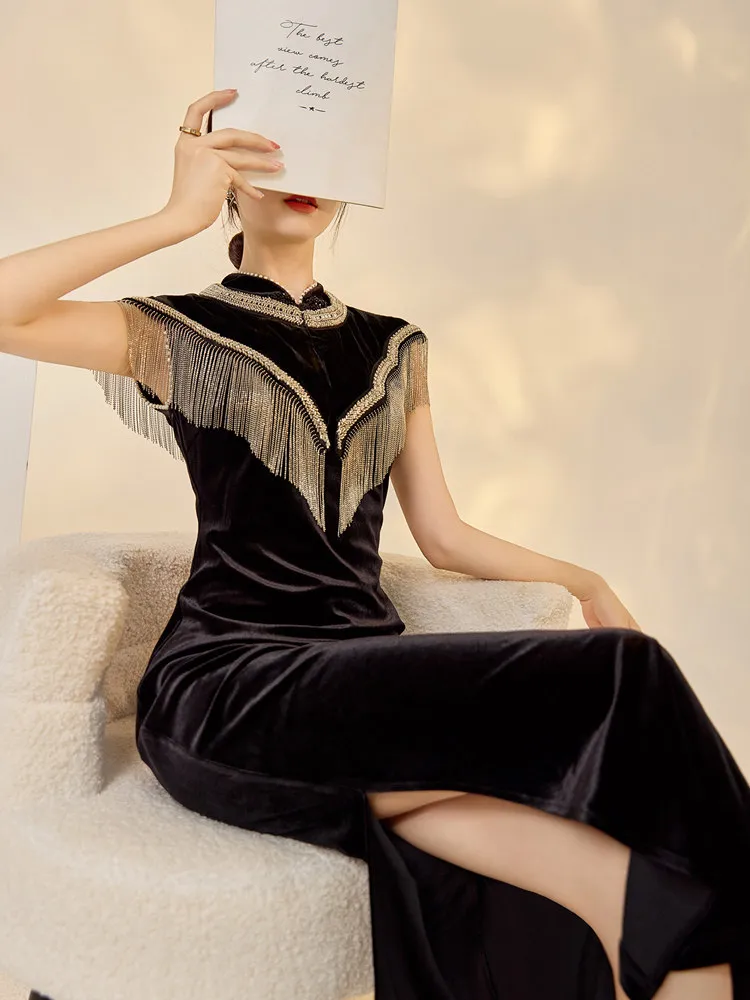
Photo: minimalist velvet dress elegant woman simple styling luxury fashion, via www.weqipao.com
There is a peculiar tension at the heart of velvet dressing — one that separates the truly sophisticated from the merely extravagant. The fabric is, by every measurable standard, among the most visually commanding textiles in existence. Its pile catches and absorbs light in a manner that no other material can replicate. Its surface shifts between shadow and luminosity with the slightest movement. And yet, the most compelling velvet looks in recent memory share a single, counterintuitive quality: they are almost startlingly simple.
This is the velvet paradox. The richer the fabric, the greater the demand for restraint.
Why Velvet Resists Embellishment
To understand why velvet and excess are fundamentally incompatible, one must first appreciate what velvet actually does to light. Unlike silk, which reflects brilliance outward, or linen, which absorbs it flatly, velvet creates a phenomenon called pile shadow — a dynamic interplay between the direction of the weave and the angle of illumination. This gives a single velvet garment the visual complexity of an entire curated outfit.
When you introduce competing elements — layered necklaces, statement earrings, ornate belts, bold prints beneath an open jacket — you are essentially asking several strong voices to speak simultaneously. The result is not harmony. It is noise.
Fashion editors who cover the American luxury market have noted this shift with particular clarity over the past two seasons. At trunk shows hosted by heritage American luxury retailers in cities like New York and Chicago, the styling direction has moved decisively toward single-statement dressing: one velvet piece, one point of interest, and deliberate negative space everywhere else.
The Accessories Equation
If velvet is the protagonist of an outfit, accessories must accept the role of supporting cast — and a restrained one at that. The instinct to "complete" a velvet look with jewelry often works against the garment rather than for it.
Consider the velvet midi dress styled for an evening engagement. The fabric itself, particularly in deep jewel tones such as sapphire, forest green, or burgundy, carries enough chromatic and textural information to constitute a complete visual statement. A single fine-chain bracelet or a pair of understated gold studs honors that statement. A chandelier earring, a cocktail ring, and a beaded clutch actively diminish it — redirecting the eye toward peripheral details and away from the garment's central power.
Luxury style influencers with significant American followings have built entire aesthetics around this principle. The approach, sometimes described as "quiet luxury" in broader fashion discourse, finds perhaps its most natural expression when applied to velvet. The fabric is inherently loud in the most aristocratic sense of the word. It requires no amplification.
Silhouette as a Form of Silence
Beyond accessories, the question of silhouette is equally consequential. Velvet in complex, highly constructed forms — ruched bodices, tiered skirts, exaggerated sleeves — compounds visual richness to a point of diminishing returns. The eye, confronted with both the fabric's texture and an elaborate architectural shape, struggles to process either with full appreciation.
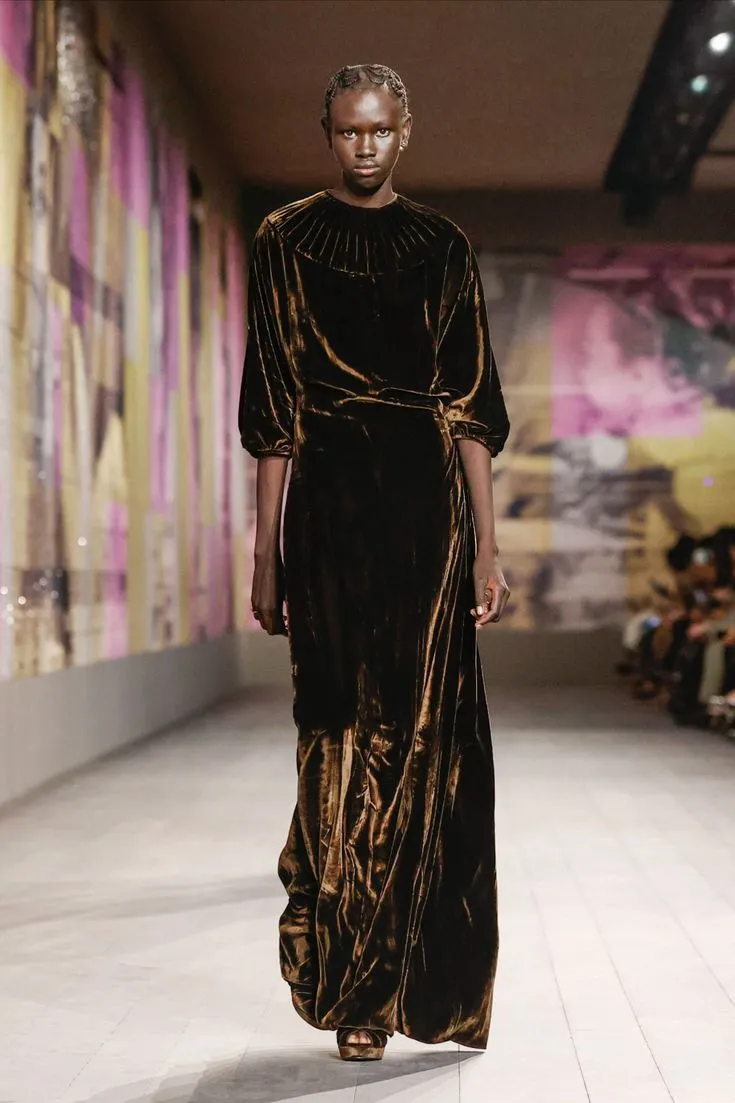
The most enduring velvet silhouettes in American luxury dressing tend toward clean geometry: the straight-cut blazer, the column gown, the relaxed wide-leg trouser. These shapes function as a kind of visual silence — a neutral backdrop against which the fabric's inherent drama can unfold without interference.
This does not imply that velvet dressing must be severe or austere. Softness of line is entirely compatible with restraint. A gently draped velvet skirt, for instance, allows the fabric's movement and pile to express themselves freely, while the simplicity of the cut ensures that nothing competes with that expression.
Color and the Art of Deliberate Contrast
One area where velvet dressing permits — and indeed rewards — a degree of boldness is in the relationship between the velvet piece and the neutral elements that surround it. Velvet in a single saturated hue, worn against the simplest possible complementary tones, achieves a kind of elegance that multiple competing colors never can.
The American luxury consumer has shown a particular affinity for this approach: a deep teal velvet blazer over an ivory silk blouse and tailored cream trousers, for example. The blazer becomes the entire conversation. Everything else exists only to frame it.
This restraint in color extends to footwear and bags as well. Quiet leather in a complementary or neutral tone — cognac, black, or nude — grounds a velvet look without pulling focus. A printed or embellished shoe worn with velvet is, in most styling contexts, a competition that neither piece wins.
What Understatement Actually Communicates
There is a social dimension to this principle worth acknowledging. In American luxury culture, the ability to resist embellishment signals something that excessive ornamentation cannot: confidence. The person who wears a single piece of extraordinary velvet, unadorned and unsupported by layers of accessory armor, communicates an understanding of their own presence that no amount of decoration can manufacture.
This is why fashion editors, stylists, and luxury brand directors — those who work most intimately with premium textiles — so consistently dress in this manner. They have learned, through sustained exposure to the finest materials, that the fabric is always enough. The discipline lies in trusting it.
Practicing Restraint: A Practical Framework
For those accustomed to more layered approaches to dressing, adopting a minimalist philosophy around velvet requires a deliberate recalibration of habit. A useful starting point is the subtraction method: assemble the look as you normally would, then remove one element. Then remove another. Observe at each stage whether the velvet piece grows more or less commanding. In nearly every case, the answer will clarify itself.
Another practical approach is to let the velvet piece determine the occasion, rather than styling it to fit an occasion. A velvet blazer that commands a dinner reservation needs no further assistance. A velvet skirt that transforms a winter afternoon into an event is already doing sufficient work.
At Velourss, our conviction is that velvet's true luxury lies not in what surrounds it, but in what it reveals when given room to breathe. The paradox, ultimately, is not so paradoxical at all. Restraint is simply the highest form of respect for a fabric this extraordinary.