Provenance in the Pile: Why America's Finest Velvet Was Worn Decades Ago
The most coveted velvet in America rarely arrives on a hanger with a price tag. More often, it emerges from a cedar trunk in a Boston brownstone, or surfaces at a Thursday-morning estate sale in a shuttered Connecticut colonial, folded in acid-free tissue and smelling faintly of lavender and time.
The resale market for vintage velvet — once a niche corner of the estate trade — has become one of the most quietly competitive arenas in American luxury fashion. And unlike so much of the contemporary market, its value is measured not in novelty but in endurance.
The Estate Sale as Front Line
For dealers like those working the New England estate circuit, the hunt begins before the doors open. A 1960s silk velvet opera coat in oxblood, its pile still dense and luminous, can command a four-figure sum from a reseller who knows exactly what they are holding. The tell, veterans say, is in the hand: silk velvet from the mid-century mills of Lyon, Italy, or the now-defunct American silk houses has a weight and drape that synthetic imitations cannot counterfeit.
"You learn to read a garment the way an appraiser reads a signature," one Providence-based estate buyer explains. "The selvedge, the lining, the way the pile falls when you run your palm against the nap. New velvet performs. Old velvet confesses."
The Los Angeles School of Curation
On the West Coast, the trade has taken on a more deliberate character. A handful of boutiques along Melrose and in the quieter corridors of Santa Monica have built their identities around archive-grade textile pieces — velvet gowns from Hollywood's studio era, smoking jackets from the postwar years, opera coats that have outlived their original owners by half a century.
These shops operate less like retail and more like consultancies. Appointments are common. Provenance files, complete with photographs and condition reports, accompany significant pieces. The clientele, largely drawn from Los Angeles's entertainment and design communities, arrive seeking singular garments — the kind that cannot be reordered, replicated, or encountered on another guest at a dinner party.
The distinction matters. In a market where luxury is increasingly defined by scarcity of experience rather than scarcity of goods, a garment with a documented past offers something no new production can: an unrepeatable story.
The Restorer's Bench
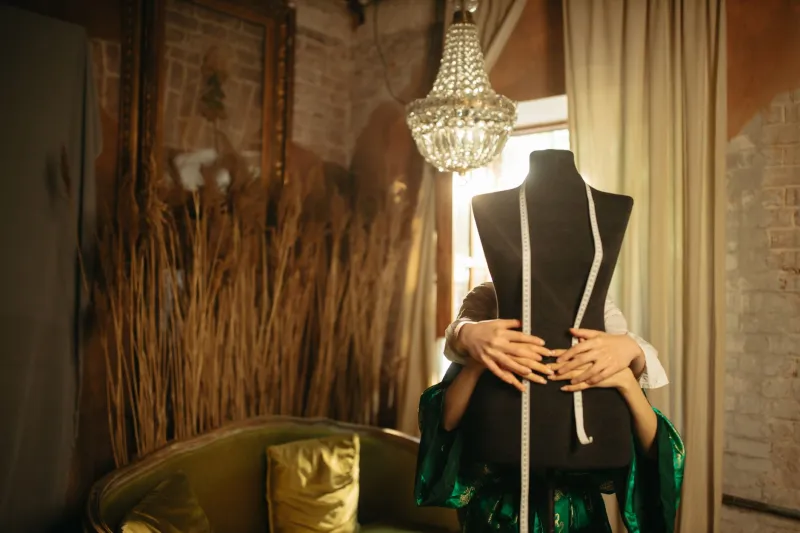
Between the estate sale and the boutique floor stands a small, essential profession. Textile restorers — many trained in museum conservation — rebuild shattered silk velvet, invisibly re-weave moth losses, and stabilize seams that were sewn by hand seventy years ago.
Their work is slow and unglamorous. A single crushed sleeve may require hours of steaming, padding, and nap-raising before the pile recovers its original depth. But the economics are persuasive: a restored 1950s velvet evening coat, professionally conserved, routinely outvalues a comparable new piece from a contemporary luxury house.
"People assume age is damage," one New York-based restorer notes. "With quality velvet, age is character. Our job is simply to let the garment speak in its original voice."
A Different Definition of Investment
Collectors drawn to this market describe their acquisitions in terms that sound closer to art patronage than shopping. A velvet piece is evaluated for its mill, its era, its condition, and its lineage — the same criteria applied to a lithograph or a piece of silver.
The logic holds up under scrutiny. Mid-century silk velvet was produced in quantities no modern atelier would attempt, using weaving techniques and fiber quality that have largely disappeared. Each surviving garment represents a finite supply. As the decades pass and condition-worthy pieces grow scarcer, values have moved in only one direction.
The New Etiquette of the Second Life
There is, among serious collectors, an unspoken code. Provenance is disclosed. Restorations are documented. Pieces are passed along — sometimes back to the market, sometimes to a daughter or a goddaughter — rather than merely consumed.
It is a quiet rebuke to the disposability of contemporary fashion, and a reminder that true luxury has always been defined by touch, history, and restraint. The finest velvet in an American closet today may well have attended an opera in 1962, waited decades in a trunk, and emerged ready for its next act.
The pile, pressed gently under a knowing hand, remembers everything.