The Quiet Addresses: Where America's Established Families Source Their Velvet

There is a particular silence on the upper floors of certain Madison Avenue buildings — the hush of carpeted corridors, the murmur of a fitter's voice, the soft fall of a velvet bolt being unrolled across a marble table. The wealthiest families in America do not find their velvet. They are introduced to it.
The Unmarked Door
The first rule of serious velvet procurement is that the finest sources rarely advertise. In New York, several of the most respected textile houses occupy floors above retail street level, reachable only by appointment or by referral. A name whispered at a dinner party in Southampton carries more weight than any storefront window.
This discretion is not affectation; it is commerce. Family-owned ateliers in Manhattan, Charleston, and San Francisco have spent generations cultivating client lists rather than customer bases. A fourth-generation milliner on King Street keeps ledgers going back to the 1950s — orders for hunting-green velvet, for midnight-blue evening wraps, for the same deep bordeaux a family has commissioned every autumn for sixty years.
The Ritual of the Bolt
Walk into a department store and velvet is presented folded, tagged, and lit for impulse. Walk into a heritage house and the experience is inverted. Bolts are brought out one at a time. The cloth is draped across the forearm, then the wrist, so the client can watch how the pile catches and releases light as the fabric moves.
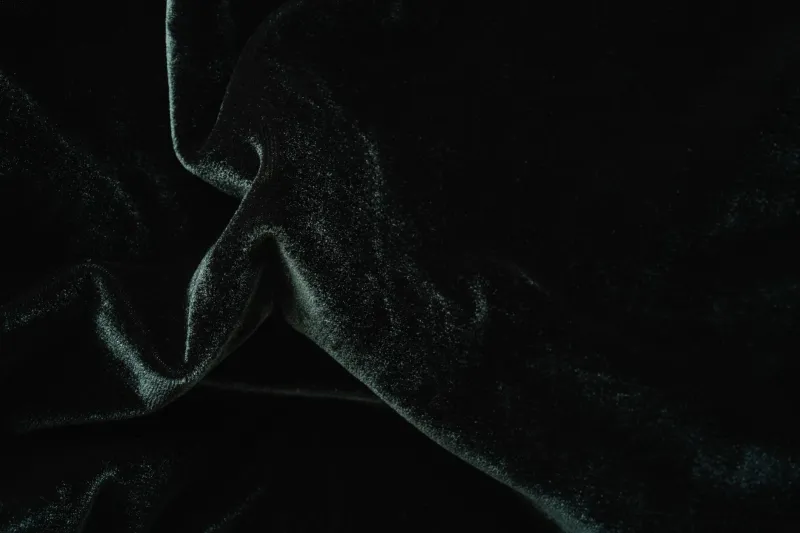
The examination is tactile before it is visual. A practiced buyer will draw a hand against the nap, then against the grain, feeling for density, for the depth of the pile, for the particular resistance that distinguishes silk-blend velvet from its cotton cousins. Cotton velvet has weight and honesty; silk velvet has movement and sheen; a well-made blend offers both. The dealer's role is not to sell but to translate — to say, quietly, that a certain bolt came from a Como mill that has supplied the house for three decades.
Fitting as Ceremony
Fittings at these houses follow customs that would seem antiquated anywhere else. Measurements are taken in the morning, when the body has not yet expanded with the day. Clients return for at least two, often three, sessions. Garments are cut with generous seam allowances — not out of caution, but because the house assumes the piece will outlive its owner and may one day be let out, taken in, or passed down.
The unspoken rules are learned by observation. One does not haggle; the price is the price, and asking otherwise marks the newcomer. One does not rush a delivery; a velvet coat cut properly in November may not be ready until the following season, and no one at the house will apologize for it. Perhaps most importantly, one does not discuss prices — or even the house itself — outside its walls.
Charleston, Chicago, and the Regional Houses
New York holds the crown, but it does not hold the monopoly. Charleston's Society Street tailors have dressed the same Lowcountry families for over a century, favoring heavier cotton velvets suited to humid summers and unheated plantation houses turned venues. In Chicago, a small atelier near Oak Street has long served the city's mercantile dynasties with a distinctly Midwestern pragmatism: fewer flourishes, impeccable construction, velvet chosen for endurance over spectacle.
What unites these houses is a shared philosophy — that velvet is not a trend to be purchased but a material to be invested in, maintained, and eventually bequeathed.
The New Admission
Heritage houses are quietly adapting. Several now accept clients by way of a well-written email rather than a referral letter alone, and a handful maintain discreet e-commerce for accessories while reserving made-to-measure work for the fitting room. The ritual endures because it cannot be digitized: the weight of the bolt, the fitter's chalk, the patience of a garment that arrives when it is ready.
For those willing to learn the etiquette, the door is not locked. It is simply unmarked — and that, in the end, is the point.