In the Hand: The Unseen Grammar of Judging Velvet Like a Connoisseur
There is a ritual observed in the finer fabric showrooms of New York, Milan, and a handful of unassuming mill towns across the Carolinas. The customer does not ask to see the velvet. They ask to touch it. A swatch is placed across the palm, draped over the forearm, and held to the light only afterward. The verdict is often rendered before the eyes are permitted to weigh in.
This is not affectation. It is literacy. And for the affluent consumer preparing to invest in a garment that may outlive its first decade of wear, learning to read velvet through the fingertips is the single most valuable skill one can acquire.
Why the Hand Knows First
Velvet is, by construction, a fabric of density. Its character lives in the pile — thousands of cut fibers standing perpendicular to the ground cloth — and the quality of that pile cannot be faked at a distance. A polyester blend photographed under studio lighting may pass for silk velvet on a screen. In the hand, the deception collapses within seconds.
"The hand tells you everything the label won't," says a third-generation mill owner we spoke with in North Carolina's fading textile corridor, where a handful of American ateliers still weave pile fabrics on repurposed dobby looms. "Cheap velvet feels like a hug from a stranger. Good velvet feels like a handshake. There's intention in it."
What the fingers are detecting is a convergence of factors: fiber content, pile height, ground-weave construction, and finishing. Each leaves a signature.
The Three Tests That Matter
1. Weight Against Expectation
Genuine silk velvet and high-grade cotton velveteen carry a particular heft — substantial without being leaden. Fold a swatch over your hand and note how it settles. Synthetic velvets tend toward either featherweight insubstantiality or a dense, rubbery deadness. The former lacks the drape to fall beautifully; the latter will never breathe against the skin.
A useful benchmark: a quality silk-blend velvet blazer fabric typically falls between eight and fourteen ounces per linear yard. If a bolt feels conspicuously lighter than its visual presence suggests, the pile is likely thin or the ground weave compromised.
2. The Drape Trial
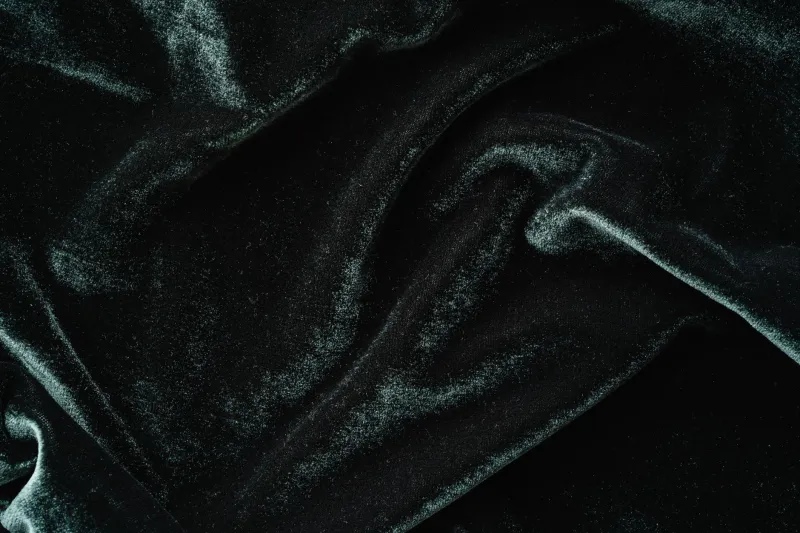
Hold the fabric by a corner and let it fall. Superior velvet drops in soft, rounded folds — what tailors call a "wet" drape — rather than standing away from the body in stiff planes. Rotate the swatch as it hangs. Notice how the pile catches light at shifting angles: this is the famous velvet shimmer, and it only appears when the pile is even and dense enough to reflect light uniformly.
Uneven reflection — bright here, dull there — signals crushed or irregular pile, a hallmark of mass production.
3. The Stroke and the Return
Run your palm across the surface in one direction, then against it. This is the nap test, and it reveals more than any fiber-content tag. Fine velvet offers a distinct directional contrast: smooth and luminous with the nap, matte and slightly resistant against it. Then press the pile flat with a fingertip and release. Quality pile recovers with springy alacrity. Pile that stays crushed, or springs back unevenly, will look tired after a season of wear.
Learning From the People Who Weave It
American mills may be few, but their standards remain instructive. At the small operations still producing pile fabrics domestically — concentrated in the Southeast, with satellite workshops in New England — quality control is conducted almost entirely by hand. Workers pull lengths from the loom and read them the way a sommelier reads a first sip.
"We reject fabric the eye would call perfect," one finishing supervisor told us. "The hand finds the thin spots. It always finds them."
This tactile rigor extends to the finishing stage, where density is measured not in abstract numbers but in the fabric's behavior under steam, under pressure, under the passage of a hand. It is a discipline the consumer can borrow wholesale.
A Buyer's Field Guide
For those evaluating a velvet garment or bolt in person — whether at a Manhattan atelier, a Savile Row-trained tailor's studio, or a heritage department store — we recommend a simple protocol:
- Weigh it. Drape the garment over your forearm. It should feel present, not heavy. Ask about fiber content; silk, cotton, and wool blends each behave differently.
- Crush a corner. Discreetly compress a small section of pile between thumb and forefinger. Watch the recovery. Five seconds should restore it.
- Read the nap in daylight. Step toward a window. Quality velvet shifts tone as you turn; flat velvet merely changes brightness.
- Inspect the seams. On finished garments, pile direction should be consistent across every panel. Mismatched nap is the surest sign of careless cutting.
- Ask about origin. Italian and Japanese mills dominate the luxury tier, but a small coterie of American producers merits attention — and often offers superior traceability.
The Deeper Argument for Touch
There is a philosophical dimension to all of this that speaks to something larger than fabric. In an era when luxury is increasingly transacted through screens — where a garment's appeal is engineered for the camera rather than the body — the act of judging velvet by hand is a small act of resistance. It insists that clothing be experienced, not merely viewed.
The connoisseurs who built America's great private collections of couture understood this instinctively. They did not buy photographs. They bought objects, and they knew them first through the palm.
The next time a velvet garment tempts you, decline the mirror. Close your eyes. Let the fabric speak in the only language that cannot be retouched — and trust what it says.