The Quiet Power Play: How True Connoisseurs Wear Velvet Without Showing Their Hand

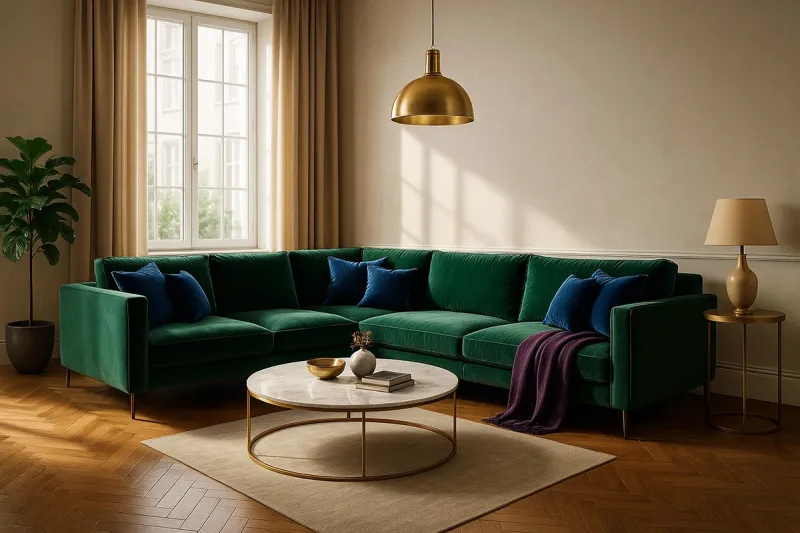
Photo by Photo by Mathias Reding on Unsplash on Unsplash
There exists, within the lexicon of American luxury dressing, a peculiar contradiction that separates the genuinely affluent from those merely performing affluence. It is the deliberate choice to possess something extraordinary and then, with full intention, conceal it. Nowhere is this contradiction more artfully resolved than in the strategic deployment of velvet—a fabric whose tactile magnificence is, paradoxically, most powerful when it is least visible.
This is not minimalism for its own sake. It is not restraint born of insecurity or indifference. It is, rather, the most sophisticated form of sartorial confidence available to the modern American dresser: the knowledge that the right people will find the velvet, and that finding it will mean infinitely more than seeing it ever could.
The Psychology of the Hidden Signal
Consumer behavior research has long established that the wealthiest tier of luxury buyers systematically moves away from logo-driven, immediately legible status signals. What replaces those signals, however, is rarely discussed with adequate nuance. The answer, in many cases, is texture—and velvet, with its unmistakable pile and its resistance to imitation, functions as the ultimate covert currency.
When a New York investment partner reaches across a conference table and the sleeve of their jacket reveals, only upon contact, the dense warmth of silk-backed velvet, something transactional occurs that no visible branding could achieve. The person on the receiving end of that handshake has been quietly inducted into a moment of shared recognition. They have been told, without words, that the individual across from them operates at a register most people never encounter.
This is the psychology at the heart of the velvet paradox: the fabric communicates most fluently to those who already speak its language. For everyone else, it remains entirely silent.
The Interior Architecture of Luxury
The most underexamined canvas in high-end American tailoring is the interior of a garment. A bespoke overcoat lined in midnight-toned velvet—visible only when the coat opens or when the wearer removes it in a private setting—represents a level of intentionality that mass luxury cannot replicate. The velvet lining is not for the street. It is for the dinner table, the private club, the moment the coat is draped across a chair in a room where the company is select.
Similarly, the interior lapel—the underside of a suit jacket's facing, invisible during wear—has become one of the most quietly prestigious sites for velvet application in contemporary American tailoring. A charcoal wool suit with a velvet-lined lapel reverse tells its story only when the jacket is open, only when someone is close enough to notice, and only when that person possesses the eye to recognize what they are seeing. These are not accidental audiences. They are curated ones.
At Velourss, this philosophy of interior luxury informs how we approach the relationship between velvet and the body. The fabric's greatest gift may not be its visual drama but its haptic intimacy—the way it exists, first and foremost, as a private experience between the wearer and the textile itself.
Silhouette as Concealment Strategy
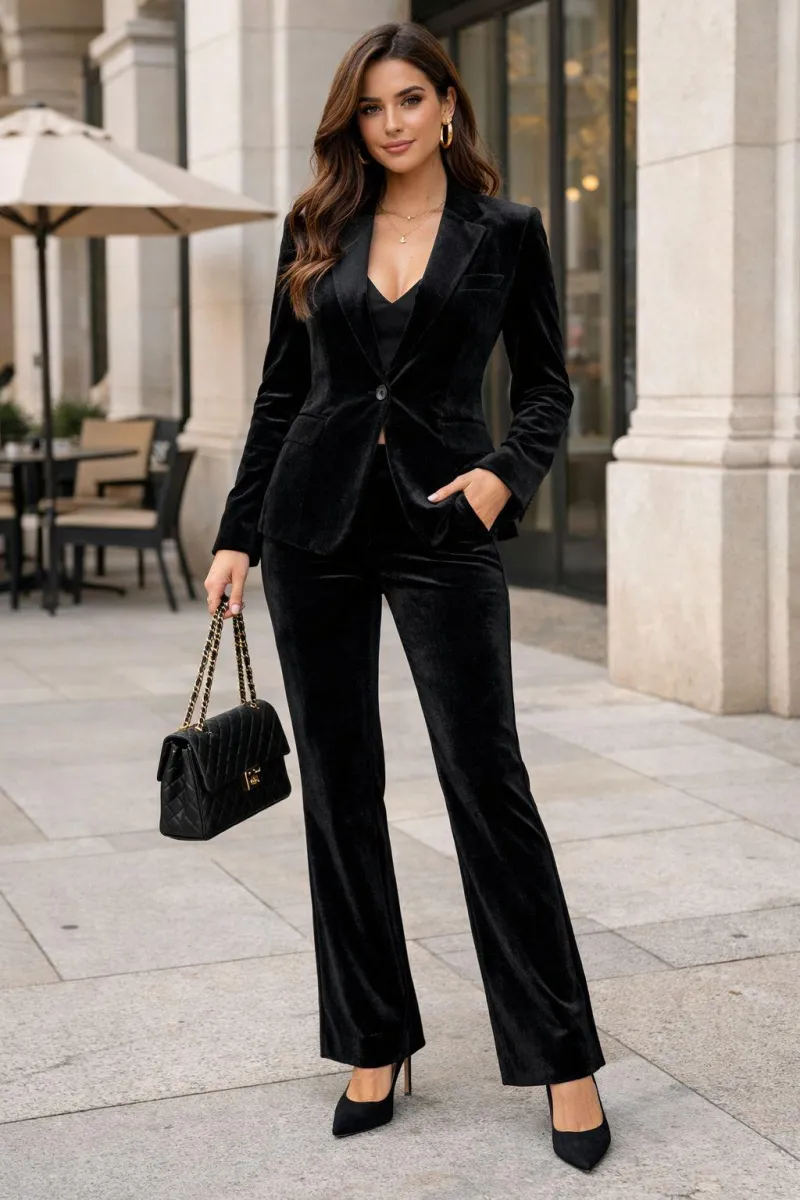
Beyond placement, silhouette itself becomes a tool of strategic understatement. A velvet garment cut in a spare, architectural line—a column dress, a single-button blazer with clean shoulders, a straight-leg trouser in crushed velvet—strips the fabric of its theatrical associations and repositions it within a vocabulary of precision and control.
The American luxury consumer who selects a black velvet turtleneck in a matte, low-pile finish and pairs it with tailored ivory crepe trousers is not hiding their choice. They are, rather, editing it. The velvet is present, but it does not announce itself. It waits. And in that waiting, it accumulates a kind of authority that louder choices dissipate immediately.
Color participates in this strategy as well. The most covert velvet deployments favor tones that absorb rather than reflect attention: deep espresso, saturated forest green, the particular navy that reads almost black in low light. These are not the colors of velvet that dominates a room. They are the colors of velvet that rewards the room for paying closer attention.
Professional Environments and the Stakes of Subtlety
In high-stakes American professional settings—boardrooms in Chicago's Loop, law firms along Park Avenue, venture capital offices in San Francisco's Financial District—the calculus of dressing carries consequences that social environments do not. The margin for misreading is narrow. Velvet, with its historical associations with leisure, performance, and aristocratic ease, can register as a miscalculation if deployed without precision.
And yet, precisely because of those associations, velvet deployed with precision communicates something that no other fabric can: that the wearer is sufficiently established to make unconventional choices and sufficiently skilled to make those choices disappear into authority rather than distraction. A velvet pocket square, folded flat in a single presidential fold, adds a whisper of texture to a boardroom look without disrupting its gravity. A velvet collar on an otherwise austere wool coat speaks only to those who look twice—and the people who look twice in those rooms are exactly the people whose attention is worth holding.
The Art of Dressing for the Second Look
There is a particular kind of elegance that reveals itself only in stages. The first impression is composed, controlled, and entirely conventional by the standards of its environment. The second impression—the one that arrives when someone is close enough to register the pile of a velvet cuff, the depth of a velvet-lined breast pocket, the weight of a velvet-trimmed hem—is where the true statement resides.
Dressing for the second look requires a degree of patience and self-possession that is itself a form of luxury. It asks the wearer to resist the immediate gratification of visible impact in favor of a slower, more selective form of recognition. It is, in this sense, the sartorial equivalent of understatement in conversation: the mark of someone who has nothing to prove and everything to offer.
This is the velvet paradox fully realized. The fabric that could, in other hands, become spectacle becomes, in the hands of the truly discerning, a private language. It is spoken quietly, heard only by those who have earned the frequency, and it communicates, without equivocation, that the wearer understands something about luxury that most people spend their entire lives trying to purchase and never quite manage to feel.