Opulence in Reserve: The Strategic Art of Wearing Velvet Without Excess
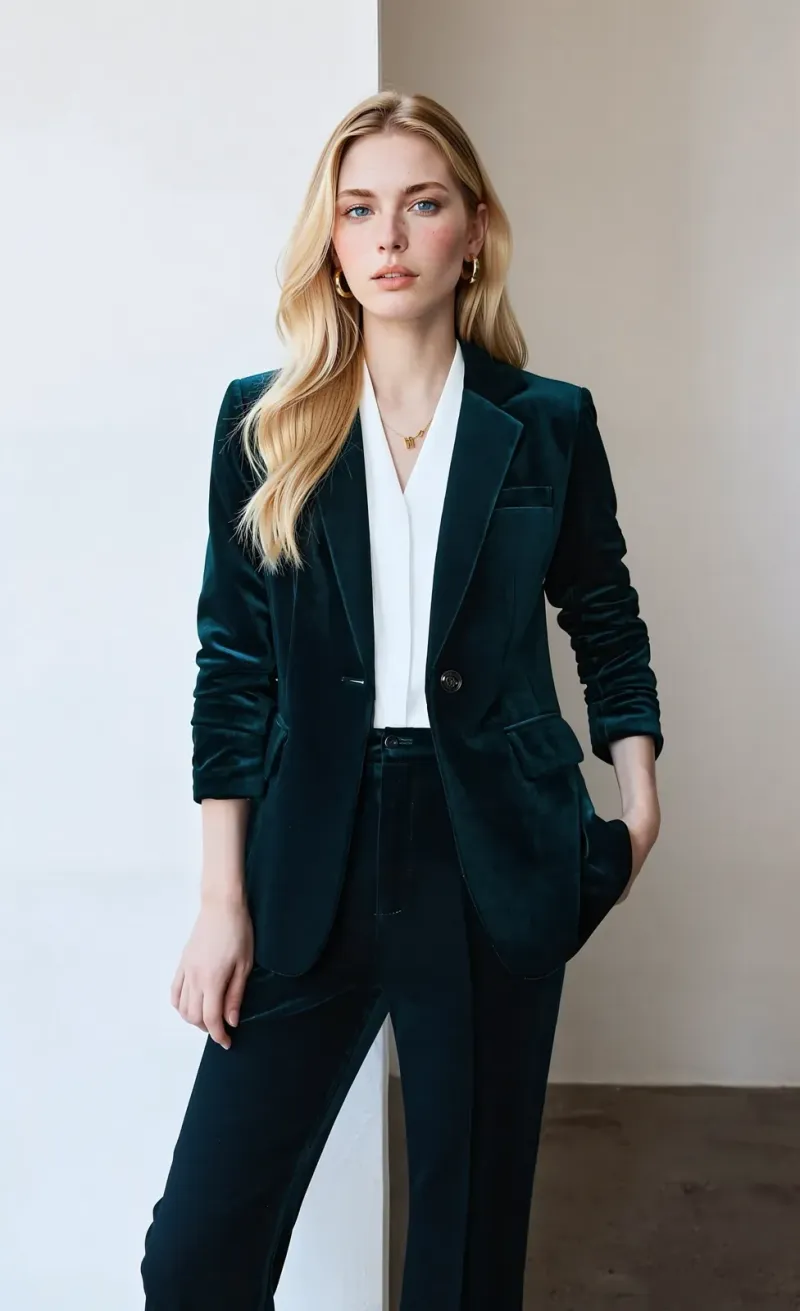
Photo: minimalist luxury velvet blazer tailored outfit editorial fashion, via 3niceclothing.com
There exists a particular tension at the center of velvet dressing that few fabrics can claim. On one side stands the textile itself — dense, luminous, and physically commanding in a way that synthetic or lightweight materials simply cannot replicate. On the other stands the contemporary affluent consumer, increasingly drawn to the kind of quiet, disciplined elegance that resists spectacle. Reconciling these two forces is not merely a styling challenge. It is, for those who understand it fully, an act of sophisticated self-expression.
Velvet does not whisper. It does not recede into the background of a room or defer to the garments surrounding it. Its pile — the woven loops that give the fabric its characteristic depth — catches light differently depending on the direction from which it is viewed, creating a visual dynamism that is entirely its own. This is the quality that has made velvet synonymous with royalty, theatrical grandeur, and ceremonial weight across centuries of Western and Eastern dress. And it is precisely this quality that makes wearing too much of it at once feel less like luxury and more like noise.
The Psychology of Restraint Among High-Net-Worth Dressers
Luxury fashion psychologists have observed a marked shift in how affluent American consumers relate to conspicuous material. Where previous generations of wealth-signaling dress leaned heavily into maximalism — multiple statement pieces, layered prints, visible logos — today's high-net-worth individual is more likely to seek what researchers sometimes call considered abundance: the deliberate selection of a single, impeccable element that communicates taste rather than simply broadcasting cost.
Velvet fits this paradigm with remarkable precision, but only when handled correctly. A blazer in midnight navy velvet, worn against a matte ivory shirt and tailored charcoal trousers, does not compete for attention — it earns it. The fabric's inherent richness does the communicative work without requiring amplification. Conversely, a velvet blazer paired with velvet trousers and a velvet accessory collapses the hierarchy of the outfit entirely, reducing the textile's power to something closer to costume.
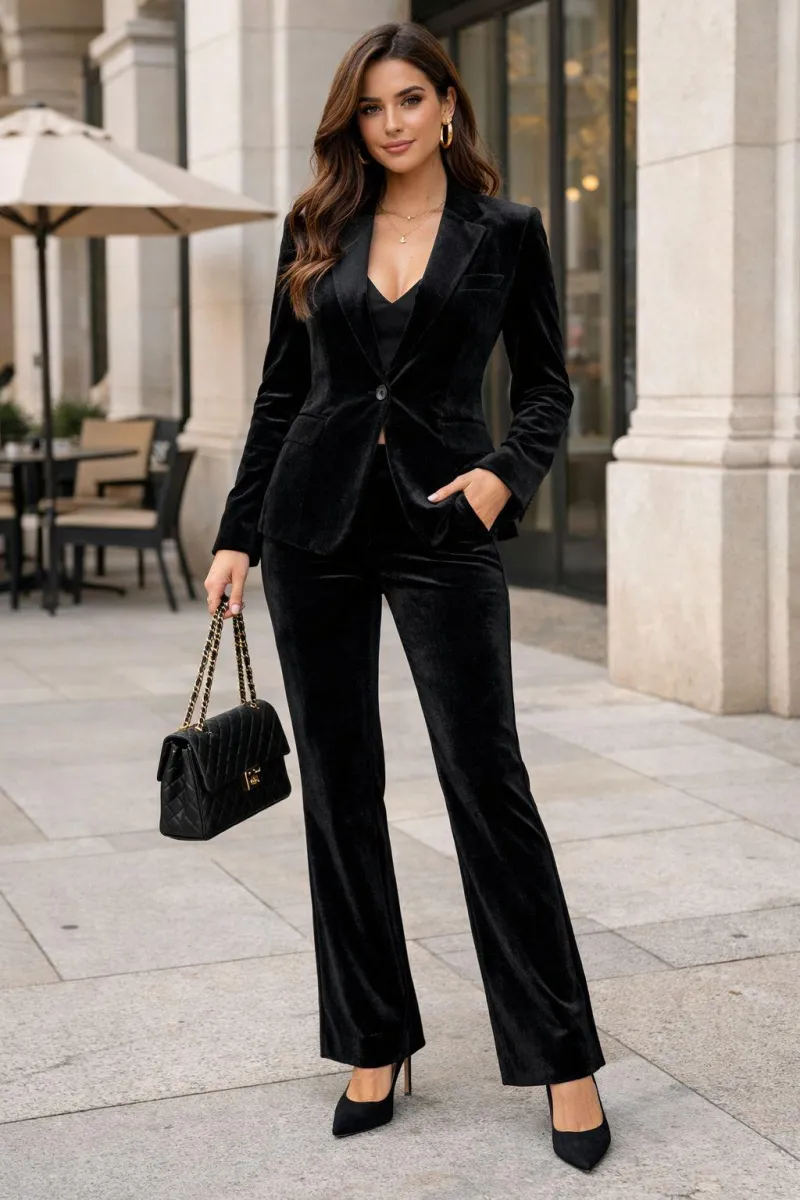
The principle luxury stylists return to repeatedly is this: velvet should occupy a singular position within any given ensemble. It should be the answer to a question, not the question itself.
Identifying Your Velvet Anchor
The concept of the velvet anchor — a single velvet garment or accessory around which a restrained, complementary outfit is constructed — is central to modern strategic dressing with this fabric. Identifying which piece serves that role requires an honest assessment of both occasion and personal silhouette.
For professional environments, the anchor is most effectively a structured piece: a tailored jacket, a fitted blazer, or a well-cut trouser in a deep, saturated hue. Jewel tones — sapphire, burgundy, forest green, and deep plum — carry particular authority in these contexts, resonating with the boardroom aesthetics that have come to define elevated American workwear. The surrounding garments should be deliberately understated: fine wool, silk, or high-quality cotton in neutral tones that allow the velvet to define the composition.
For evening occasions, the calculus shifts somewhat. A velvet slip dress or a richly constructed velvet dinner jacket can carry an entire look without accessories that compete. The most effective pairings in these contexts tend toward simplicity — a single fine-metal cuff, perhaps, or a minimal shoe in complementary leather. The goal is not bareness for its own sake, but the kind of editorial clarity that allows each element its proper weight.
The Texture Contrast Principle
One of the more nuanced tools available to the strategic velvet dresser is deliberate texture contrast. Because velvet's pile creates such pronounced visual and tactile depth, it benefits enormously from being placed in conversation with materials that are its opposite in character — smooth, matte, or lightweight.
A velvet blazer layered over a fine-gauge cashmere turtleneck in a tonal palette creates a dialogue between softness and structure that neither garment could generate alone. A velvet midi skirt worn with a crisp, tucked poplin shirt draws attention to the skirt's sumptuous fall precisely because the shirt provides a counterpoint of restraint. This is not accidental styling; it is the deliberate construction of visual tension that resolves in the viewer's eye as sophistication.
American luxury consumers have increasingly embraced this approach, influenced in part by the broader cultural conversation around what fashion editors have termed quiet luxury — a mode of dressing that communicates wealth and taste through material quality and precise proportion rather than ornamentation or branding. Velvet, when deployed strategically, is perhaps the finest available expression of this ethos: it is unambiguously premium without requiring a logo to prove it.
Seasonal and Contextual Calibration
Velvet's relationship with season is another dimension that rewards strategic thinking. In the United States, the fabric's richness aligns most naturally with the fall and winter months — not merely because of temperature, but because the quality of autumn and winter light, both indoors and out, interacts with velvet's pile in ways that amplify its depth and color saturation. A deep teal velvet jacket in October candlelight is a fundamentally different visual experience than the same garment under the flat brightness of a July afternoon.
This does not mean velvet is categorically inappropriate for warmer months. Lighter constructions — crushed velvet in paler tones, or velvet deployed in smaller doses as trim or detailing — can translate across seasons without losing the fabric's essential character. The calibration, however, must be deliberate. Wearing a full velvet ensemble in August is not a bold statement; it is a failure of contextual awareness that undermines the very authority the garment is meant to project.
The Discipline of the Single Statement
Ultimately, the paradox at the heart of velvet dressing resolves into a single governing principle: that this fabric's greatest power lies in its willingness to stand alone. The most compelling velvet looks documented across American luxury fashion in recent seasons share a common quality — they are built around a single velvet element, surrounded by restraint, and worn with the confidence that comes from knowing no further amplification is required.
This demands a particular kind of discipline from the wearer. It requires resisting the impulse to accessorize beyond necessity, to match velvet with velvet, or to surround a statement piece with other statement pieces that dilute its effect. It requires trusting the textile to do what it has done for centuries: announce itself, quietly and completely, on its own terms.
For those who understand this dynamic, velvet is not merely a fabric. It is a practice — one that rewards patience, precision, and the kind of considered restraint that defines genuine luxury taste.