Mile Markers in Pile: Tracing America's Fabric Heritage from Mill Town to Southern Estate
The Case for Traveling by Fabric
There is a particular kind of collector who reads a landscape through its cloth. Where others see interstate exits and scenic overlooks, they see the ghost of a Jacquard loom in a rehabilitated Massachusetts mill or the faded pile of a velvet settee that has outlived four generations in a Savannah parlor. For the traveler who takes texture seriously, the United States offers something no European grand tour can: a continental sweep of regional traditions, each with its own hand, its own palette, and its own relationship to the fabric we hold dearest.
What follows is not a tourist itinerary. It is a route mapped for those who understand that provenance is felt before it is documented — and who would rather stand in a working atelier than read about one.
New England: The Brick-and-Mortar Origin Story
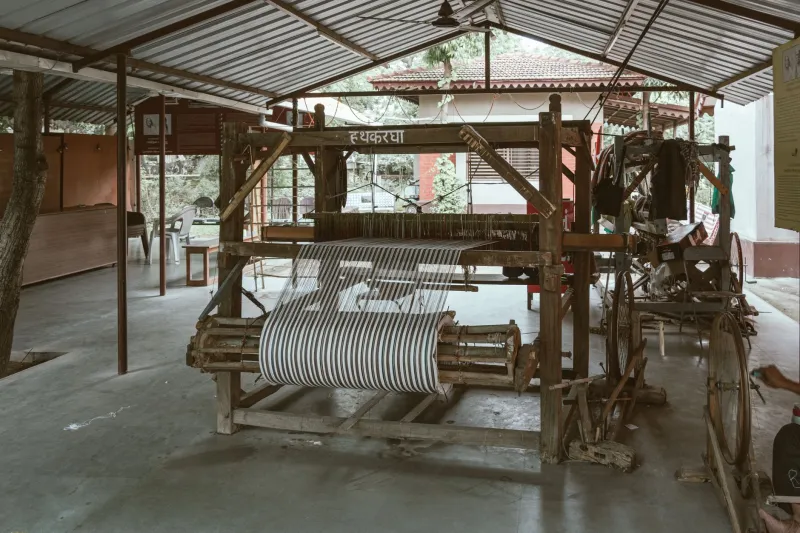
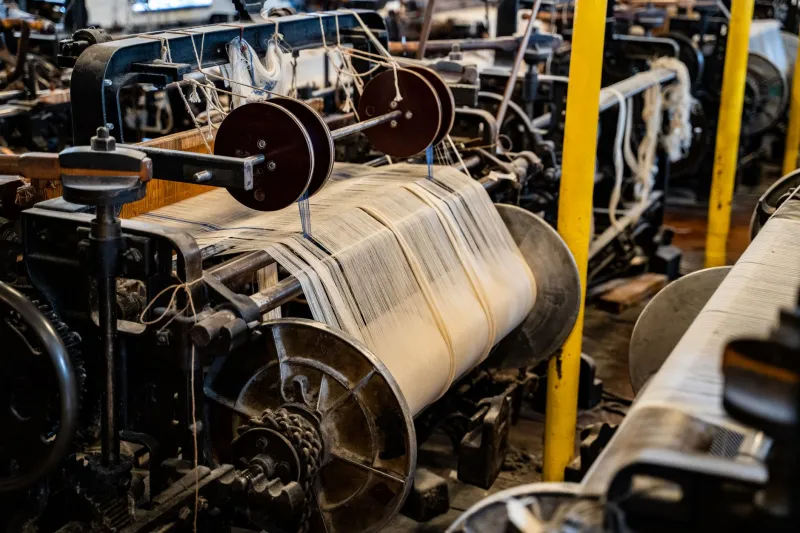
Begin where American industrial weaving began. The mill towns strung along the Merrimack and Blackstone rivers — Lowell, Lawrence, Pawtucket — remain the most legible record of the nation's textile ambition. The archives at the American Textile History Museum collections in Massachusetts and the working demonstrations in restored Rhode Island mills offer something rare: the chance to watch a shuttle fly.
Styling note for the region: New England rewards restraint. A deep forest-green velvet blazer over fine-gauge merino reads as appropriate in a converted mill's reading room and equally so at a dinner in Boston's Back Bay. Keep the palette earthy — the region distrusts shine.
The Mid-Atlantic: Archives and Ancestors
Between Philadelphia and the Delaware Valley sits the densest concentration of surviving fabric swatch books in the country. Here, the great upholstery houses of the Gilded Age left behind ledgers of woven samples — documents that function as the fashion historian's equivalent of a first-edition library. Private viewing can often be arranged through historical societies, and the effort is worth it: handling a nineteenth-century silk-velvet swatch teaches more about drape than a decade of catalogs.
Styling note for the region: This is jacket country. A midnight-blue velvet dinner jacket, worn without irony in Philadelphia or Wilmington, honors the very households whose swatch books you have just examined.
The South: Velvet as Domestic Ritual
Travel below the Mason-Dixon line and velvet changes character. In the antebellum and Victorian homes of Charleston, Natchez, and Savannah, the fabric lived less in wardrobes than in rooms — on settees, curtains, and the tufted benches of grand foyers. Estate tours here are, in effect, textile exhibitions, and the discerning visitor will notice how Southern light softens pile differently than Northern glass ever could.
Styling note for the region: The South tolerates — indeed, expects — a richer hand. Burgundy velvet trousers with a crisp white shirt feel entirely at home on a veranda in the evening; the same ensemble in Manhattan would require more nerve.
The Southwest and Pacific Coast: The Modern Atelier
The route's final act belongs to the present tense. Small studios in Santa Fe, Portland, and the Los Angeles garment district are producing limited-run velvet and plush textiles with an artisanal seriousness that echoes those New England looms a century prior. Several welcome visitors by appointment, and purchasing directly from the maker remains the surest way to acquire a piece with a story worth telling.
Styling note for the region: Western light is unforgiving and generous at once. Rust, ochre, and terracotta velvets — colors drawn from the landscape itself — outperform the traditional jewel tones here.
Packing the Wardrobe of a Textile Pilgrim
A journey of this kind demands a capsule built on the same principles it celebrates: few pieces, exceptional pile, colors that photograph honestly in both mill shadow and Southern sun. A foldable velvet travel case or garment pouch is not a luxury but a necessity — pile crushes, and crushed pile forgives slowly.
Consider the road trip itself an act of connoisseurship. Every stop on this route teaches the same lesson from a different angle: that fabric carries memory, that regions speak through their weaves, and that the most sophisticated wardrobe is one built by hand and eye rather than by algorithm.
The miles, in the end, are simply the price of admission. The pile is the destination.